# Solution Architect Portfolio Examples: Decisions and Impact
> Explain enterprise integration, modernization, and technical discovery through worked portfolio cases that connect architecture to business needs.
Source: https://self.cv/en/blog/solution-architect-portfolio-examples
Language: en
Published: 2026-11-09
Last modified: 2026-11-09T00:00:00.000Z
Self gives solution architects a way to turn a CV and project notes into an editable, hosted professional website. Use that page to explain the decisions behind your systems: the business requirement, the constraints, the alternatives, and the contribution you made.
An experienced architect may have little public code and years of enterprise work worth discussing. A useful portfolio makes that work understandable without requiring the reader to reconstruct it from a list of platforms. The following fictional cases give you a structure for presenting your own projects.
## What belongs in a solution architect portfolio?
Connect the architecture to the people and operations it serves. A technical reviewer may want to understand interfaces and failure behavior. A business leader may need the delivery trade-off, adoption plan, or commercial constraint. A short case can provide an accessible first explanation and a route into relevant detail.
Choose evidence that fits the architecture role you want.
| Focus | A useful case | Evidence to explain |
| --- | --- | --- |
| Enterprise integration | Connecting business systems around a workflow | Interfaces, data ownership, failure handling, and a key trade-off |
| Cloud or application modernization | Changing a system while operations continue | Constraints, migration stages, validation, and handover |
| Solution engineering and pre-sales | Helping a buyer evaluate a technical approach | Discovery, requirements, evaluation criteria, and a recommendation |
## Example 1: an enterprise integration case
Consider an order process that depends on a customer platform and a fulfillment system. A diagram showing three boxes and an arrow is a starting point. The interesting part is why the chosen integration matches the workflow.
- Requirement: let the customer team follow order progress without re-entering information.
- Constraint: fulfillment updates can arrive late and the two systems have different availability requirements.
- Decision: compare immediate request-response integration with queued updates and define how retries are handled.
- Your contribution: clarify data ownership, document interface expectations, and agree the operational recovery process.
- Evidence: a simplified flow, a decision summary, and a test showing what happens when an update fails.
**Example portfolio copy:** Designed an order-status integration between customer and fulfillment systems. Compared synchronous and queued approaches against availability and support requirements, clarified ownership of order data, and documented retry and recovery behavior with the delivery team.
A useful diagram shows the direction of the interaction and the relevant boundary. Add a caption explaining the decision it supports. Include a queue, identity provider, or data store only when it helps the reader follow that decision.
## Example 2: an application modernization case
Modernization is often a sequence of risk and delivery decisions. A portfolio should make that sequence visible rather than stop at the destination platform. Explain what had to continue working while the change happened.
- Requirement: replace part of a legacy service while keeping an important customer workflow available.
- Constraint: dependencies are only partly documented and the support team must operate both versions during transition.
- Decision: move one bounded capability first instead of replacing the full application at once.
- Your contribution: map dependencies, agree release boundaries, and define validation and rollback conditions.
- Evidence: a staged roadmap, a representative dependency view, and the criteria used to accept the first release.
**Example portfolio copy:** Planned a phased modernization around a business-critical workflow. Mapped service dependencies, compared replacement options, and defined the first migration boundary with engineering and operations. Prepared acceptance and rollback criteria for the initial release.
State whether you produced a design, supported a pilot, or helped deliver a production migration. Those are different contributions, and each can make a strong case when its scope is clear.
## Example 3: a solution engineering or pre-sales case
For customer-facing architects, the main achievement may be creating a sound evaluation rather than writing the final system. Show how discovery changed the recommendation and how technical evidence supported a business decision.
- Requirement: help a buyer assess whether a platform fits an existing enterprise workflow.
- Constraint: identity, integration, and operating requirements must be checked before a commercial commitment.
- Decision: test a representative end-to-end scenario instead of delivering a broad feature demonstration.
- Your contribution: run discovery, turn requirements into evaluation criteria, and coordinate the technical proof.
- Evidence: a sanitized requirement matrix, an evaluation plan, and a recommendation that explains remaining gaps.
**Example portfolio copy:** Led technical discovery and evaluation planning for an enterprise platform opportunity. Converted stakeholder requirements into a representative test scenario, coordinated identity and integration checks, and presented a recommendation covering fit, dependencies, and open questions.
## A reusable architecture case-study outline
Write a case that connects technical reasoning with a delivery context.
| Part | What to capture |
| --- | --- |
| Context | The business workflow, stakeholders, and requirement |
| Constraints | The important operating, delivery, security, or commercial limits |
| Alternatives | The approaches considered and the relevant trade-off |
| Decision | What was chosen and why it fit the context |
| Contribution | The work you owned and how you worked with others |
| Evidence and status | What was checked, what happened, and the stage reached |
This emphasis on reasoning is also useful in [AWS's architectural decision record guidance](https://docs.aws.amazon.com/prescriptive-guidance/latest/architectural-decision-records/adr-process.html), which organizes significant choices around context, the decision, and its consequences. A public portfolio can use a shorter explanation suited to its audience.
## Present technical depth within a clear professional profile
Open with your architecture focus and the setting where you apply it. Enterprise solution architect connecting integration decisions with customer and operational needs tells the reader more than a string of certifications. Follow that introduction with selected cases, career history, relevant skills, and contact details.
Charcoal gives an experienced technical profile a restrained visual structure. Corporate is another option when commercial leadership and career progression deserve equal prominence. Your portfolio can link to code, documentation, talks, or public work while keeping the main explanation accessible.
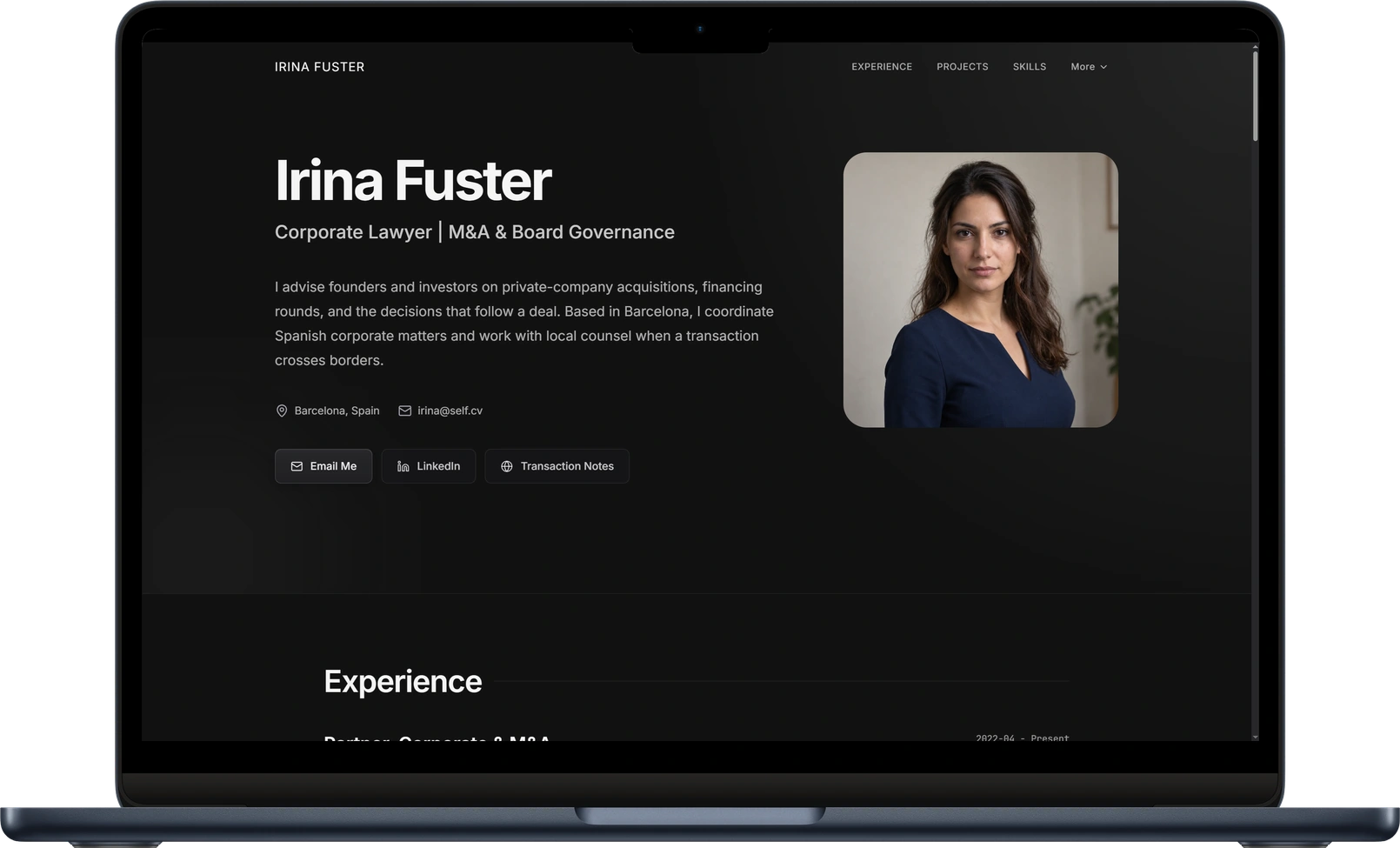
Charcoal keeps the introduction and career evidence prominent in a restrained professional layout.
[Start your architecture portfolio with Charcoal](https://self.cv/studio/pages/new?templateId=charcoal) or explore [cloud architect website examples](https://self.cv/en/cloud-architect-portfolio).
## Prepare material you can share
- Use diagrams and excerpts you have the right to publish; label recreated or illustrative material.
- Remove internal endpoints, credentials, customer data, and details that reveal a protected system.
- Separate your decisions and responsibilities from the wider team delivery.
- Describe the actual stage and evidence: proposal, lab, pilot, or production work.
## Build the website from your existing CV and notes
Bring your CV, a few short case outlines, and any public links you want to feature. Self drafts the profile from that material. Use Studio to refine the summary, select the experience that matters, and develop Projects into concise case studies. Add an image or link when it helps someone inspect the reasoning.
Review the page on desktop and mobile, then publish a link you can use in applications, introductions, and customer conversations. You can preview Charcoal and Corporate before upgrading; publishing those templates requires Pro or Team. A Free template can be published on the Free plan.
[Create your solution architect portfolio](https://self.cv/studio/pages/new?templateId=charcoal), or use the broader [engineering portfolio guide](https://self.cv/en/blog/engineering-portfolio) to plan your project selection.
## Questions about solution architect portfolios
### Do solution architects need a public GitHub portfolio?
A repository is useful when code is relevant to the role. Enterprise architecture can also be demonstrated through decisions, simplified diagrams, evaluation plans, and a clear account of responsibility. Choose evidence that supports the work you want to do.
### Can I include certification labs?
Yes. Identify them as labs and explain what you designed, tested, and learned. Keep them distinct from work operated for an employer or customer.
### How much detail should each case contain?
Give the reader enough to understand the requirement, one important decision, and your contribution. A concise explanation with a useful diagram can open the discussion; link to deeper public material when it adds evidence.