
Do AI-Written CVs All Sound the Same? The Data Says No
Of the 500 career websites in our study, 270 had English professional introductions. None were duplicates, although familiar CV phrases still appeared. The issue is editing, not inevitable sameness.

Javier Martínez Samblas
Founder of Self · AI-powered resume-to-website platform
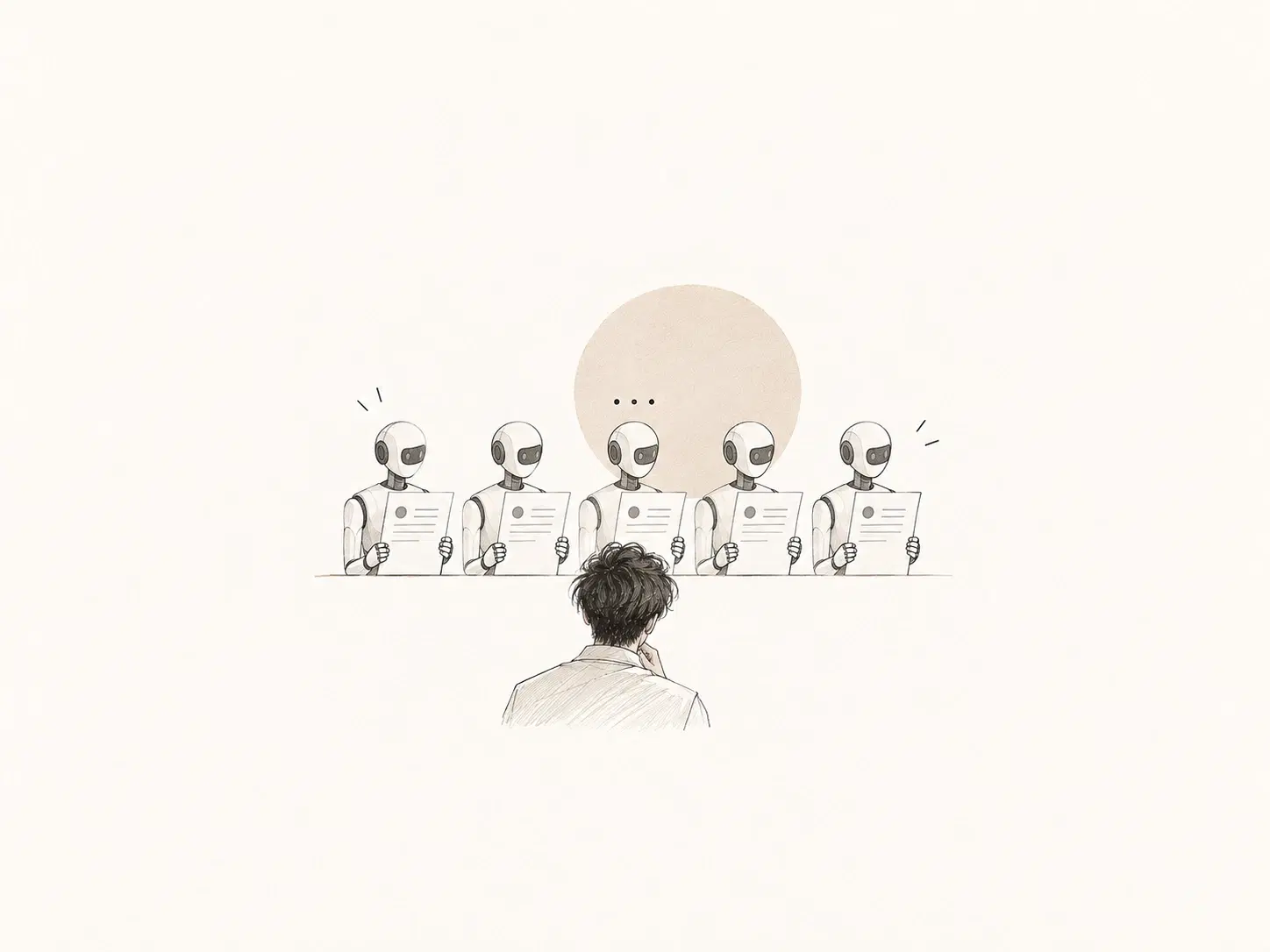
No: CV content created or refined with AI does not inevitably make every professional sound the same. Of the 500 career websites in our study, 270 had English professional introductions. Among those introductions, we found no exact duplicates and no two openings that began with the same five meaningful words. The careers remained distinct.
There is still a real editing problem. Familiar phrases such as “proven track record” and “passionate about” appeared across different profiles. AI can help organize and express a person's experience, but generic input and an uncritical final review can leave generic wording behind. The useful question is not whether AI touched the CV. It is whether the final text could only describe the person it represents.
First, separate the content from the website
This study examines words in CVs and professional introductions. It is not a test of Self's visual design. Self pages are built from templates created by a team of senior designers and product professionals, with deliberate typography, hierarchy, spacing, responsiveness, and accessibility. They are designed systems, not layouts improvised by a text generator.
AI has a different role in Self: it helps turn an existing CV into structured, editable page content and makes revision easier. The professional remains in control of the facts and final wording, while the design provides a credible setting for the story.
The clearest result: the introductions were not copies
Were any two full introductions identical?
Result
No: 0 duplicate pairs
Did any two start with the same five meaningful words?
Result
No: 0 shared openings
How many meaningful four-word sequences recurred?
Result
30, each shared by only 2 profiles
How many used at least one familiar CV phrase?
Result
170 of 270 (63.0%)
| Question | Result |
|---|---|
| Were any two full introductions identical? | No: 0 duplicate pairs |
| Did any two start with the same five meaningful words? | No: 0 shared openings |
| How many meaningful four-word sequences recurred? | 30, each shared by only 2 profiles |
| How many used at least one familiar CV phrase? | 170 of 270 (63.0%) |
The first three results matter more than a vague claim that the texts “felt different.” There were no copies, no repeated five-word opening formula, and only 30 meaningful four-word sequences appeared in more than one profile. Each of those sequences appeared in just two. At the sentence level, the sample showed substantial variety.
That makes sense. Even when people use the same tool, their employers, specialties, years of experience, industries, goals, and source CVs differ. AI does not erase those facts. Strong source material gives it something specific to organize.
Where sameness does creep in
One hundred and seventy of the 270 introductions used at least one phrase from a list of familiar CV expressions. “Skilled in” appeared in 50, “cross-functional” and “proven track record” in 40 each, and “passionate about” in 35. These are not errors, and some may be accurate. The weakness is that they occupy valuable attention without distinguishing one person from another.
Results-driven professional
A more useful question
Which result best represents your work?
Proven track record
A more useful question
What did you repeatedly deliver, for whom, and at what scale?
Passionate about innovation
A more useful question
Which problem or change genuinely holds your attention?
Skilled in cross-functional collaboration
A more useful question
Which groups did you bring together, and what became possible?
Extensive experience
A more useful question
How many years, environments, markets, or types of challenge?
| Generic wording | A more useful question |
|---|---|
| Results-driven professional | Which result best represents your work? |
| Proven track record | What did you repeatedly deliver, for whom, and at what scale? |
| Passionate about innovation | Which problem or change genuinely holds your attention? |
| Skilled in cross-functional collaboration | Which groups did you bring together, and what became possible? |
| Extensive experience | How many years, environments, markets, or types of challenge? |
The fix is not to ban particular words. It is to make them earn their place. “Passionate about accessible products” becomes more believable when followed by the audience served, the standard applied, or the product decision that demonstrates that concern.
How to use AI without losing your voice
- Give it facts before asking for polish: projects, decisions, constraints, outcomes, and the work you want next.
- Ask for two or three versions with different emphasis rather than accepting the first fluent paragraph.
- Remove any adjective that is not supported by an example elsewhere on the page.
- Read the text aloud and replace phrases you would never use in a real conversation.
- Check every fact, number, employer, date, and claim. Fluency is not verification.
- End with a human edit so the rhythm and priorities sound like you.
One practical test is to hide your name and job title. Could the introduction plausibly belong to hundreds of people? If so, add a specific audience, problem, environment, achievement, or point of view. Specificity is the strongest defense against generic writing, whether the first draft came from AI, a template, or a blank page.
What Self contributes
Self is not a machine for publishing untouched AI copy. It gives people a professionally designed starting point, structures the information from their CV, and keeps the result editable. That combination removes the technical burden of building a site while preserving the part that should remain personal: what to say, what to prove, and what to emphasize.
The strongest edit is often to replace a broad claim with evidence. Our research into measurable CV achievements includes real anonymized examples. Our analysis of 500 career websites shows how that content fits into a complete page. When the wording is ready, Self can turn the CV into a website you control.
The conclusion
The data does not support the idea that AI-written CVs must all sound the same. In this sample, the introductions were distinct at the document, opening, and phrase-sequence levels. It does support a more useful warning: polished professional clichés survive easily unless somebody edits them out.
AI is best used as an editor and organizer, not as the owner of a career story. Combine specific source material, a careful human review, and Self's professionally designed presentation, and speed does not have to come at the cost of identity.
Research note: read the shared methodology and limitations for the sample, language tests, and privacy approach used across all three studies.