

Executive Personal Website Examples: Leadership and Advisory Work
Three worked examples show how leaders, transformation managers, and fractional executives can present a substantial career on one clear personal website.

Javier Martínez Samblas
Founder of Self · AI-powered resume-to-website platform

Self turns your existing CV into an editable professional website that gives leadership experience a clear home. You can bring together your current focus, selected achievements, career history, and contact details in one link for recruiters, clients, partners, and professional introductions.
For an experienced professional, the hard part is often deciding what deserves attention. A long chronology can hide the work you want to be known for now. These three fictional examples show different ways to present your experience.
What should an executive personal website include?
A useful executive website answers a few practical questions: what do you lead, in which setting, what evidence supports that position, and how can someone reach you? It can serve an employed manager, an independent advisor, or a leader considering a new role. Choose the emphasis around the conversation you want to start.
Introduction
What it should communicate
Your present focus and the organizations or situations you can help
Selected impact
What it should communicate
A small set of decisions, responsibilities, and outcomes worth discussing
Career history
What it should communicate
The progression and operating context behind your experience
Credentials and public work
What it should communicate
Relevant qualifications, publications, talks, or external references
Contact
What it should communicate
A clear route to a professional conversation
| Section | What it should communicate |
|---|---|
| Introduction | Your present focus and the organizations or situations you can help |
| Selected impact | A small set of decisions, responsibilities, and outcomes worth discussing |
| Career history | The progression and operating context behind your experience |
| Credentials and public work | Relevant qualifications, publications, talks, or external references |
| Contact | A clear route to a professional conversation |
Example 1: an established business leader
Consider a leader whose career spans customer operations, team management, and service improvement. The opening should make the through-line visible before the reader reaches individual jobs.
Example introduction: I lead customer operations through periods of growth and organizational change. My work connects service design, team development, and operating discipline so businesses can deliver a more consistent customer experience.
Under that introduction, select two achievements that explain how you work. One might describe reorganizing responsibility across regional teams; another might explain a service handover. For each, name the situation, your decision, and the evidence of its effect. Add team size, geography, or budget only when it gives useful context.
Example achievement: Reorganized ownership of customer escalations across regional operations. Agreed decision rights with service leaders, introduced a shared review cadence, and established a clearer handover between frontline teams and specialist support.
Example 2: a transformation or program leader
Transformation work can look like a long list of systems and initiatives. A stronger personal website explains the operating problem and the change in how the business worked. This helps readers connect process, technology, and leadership.
Example introduction: I help organizations connect strategy with day-to-day delivery. My experience spans business transformation, data governance, and cross-functional programs, with a focus on clear ownership and practical adoption.
- A useful case: replacing a fragmented customer intake process with a shared operating workflow.
- Your contribution: align the service owners, agree priorities, and coordinate the implementation and handover.
- Evidence to explain: a simplified process view, the acceptance criteria, and the observed change in service delivery.
Example case summary: Led a customer-intake improvement program across operations and technology teams. Clarified service ownership, agreed a common intake process, and coordinated rollout and staff guidance so the new workflow could be used consistently.
For more on presenting this kind of work, see the project manager portfolio guide.
Example 3: a fractional executive or independent advisor
An advisor needs to make the engagement understandable. A title such as Fractional COO is a starting point; the page should explain the situation you can help with, the kind of involvement you offer, and the experience behind it.
Example introduction: I work with growing service businesses that need clearer operations before their next stage of expansion. As a fractional operating leader, I help founders establish team responsibilities, management routines, and a practical delivery plan.
Follow the introduction with two or three concrete areas of work, such as operating-model review, leadership support, or implementation oversight. Then connect those areas to relevant experience. The reader should understand what working with you could involve without reading a full company brochure.
Example engagement summary: Supported a founder moving from informal coordination to a clearer management structure. Mapped key responsibilities, introduced a regular operating review, and helped the team prioritize changes they could maintain after the engagement.
Turn a long career into a clear professional story
Start from the role or type of engagement you want to discuss now. Choose a few career highlights that substantiate it, then keep the rest of the chronology available underneath. Older roles can be concise while still showing the foundation of your experience.
Strategic leader
A more informative direction
What you lead, for whom, and through which kind of change
Delivered transformation
A more informative direction
The operating problem, the decision you owned, and what changed
Trusted advisor
A more informative direction
The people or organizations you advise and the questions you help them resolve
Extensive experience
A more informative direction
Selected roles and evidence that support your current focus
| Broad wording | A more informative direction |
|---|---|
| Strategic leader | What you lead, for whom, and through which kind of change |
| Delivered transformation | The operating problem, the decision you owned, and what changed |
| Trusted advisor | The people or organizations you advise and the questions you help them resolve |
| Extensive experience | Selected roles and evidence that support your current focus |
A short biography should connect those choices in natural language. Write as you would introduce yourself in a useful professional conversation. Keep a first-person or third-person voice consistent, and replace strings of abstract qualities with a setting, an action, and a reason it mattered.
Choose a design that gives experience room to speak
Corporate provides a structured introduction and career chronology. Charcoal offers a restrained dark presentation for the same kind of professional evidence. Choose the design that helps your audience scan the work, then shape the wording and emphasis in Studio.
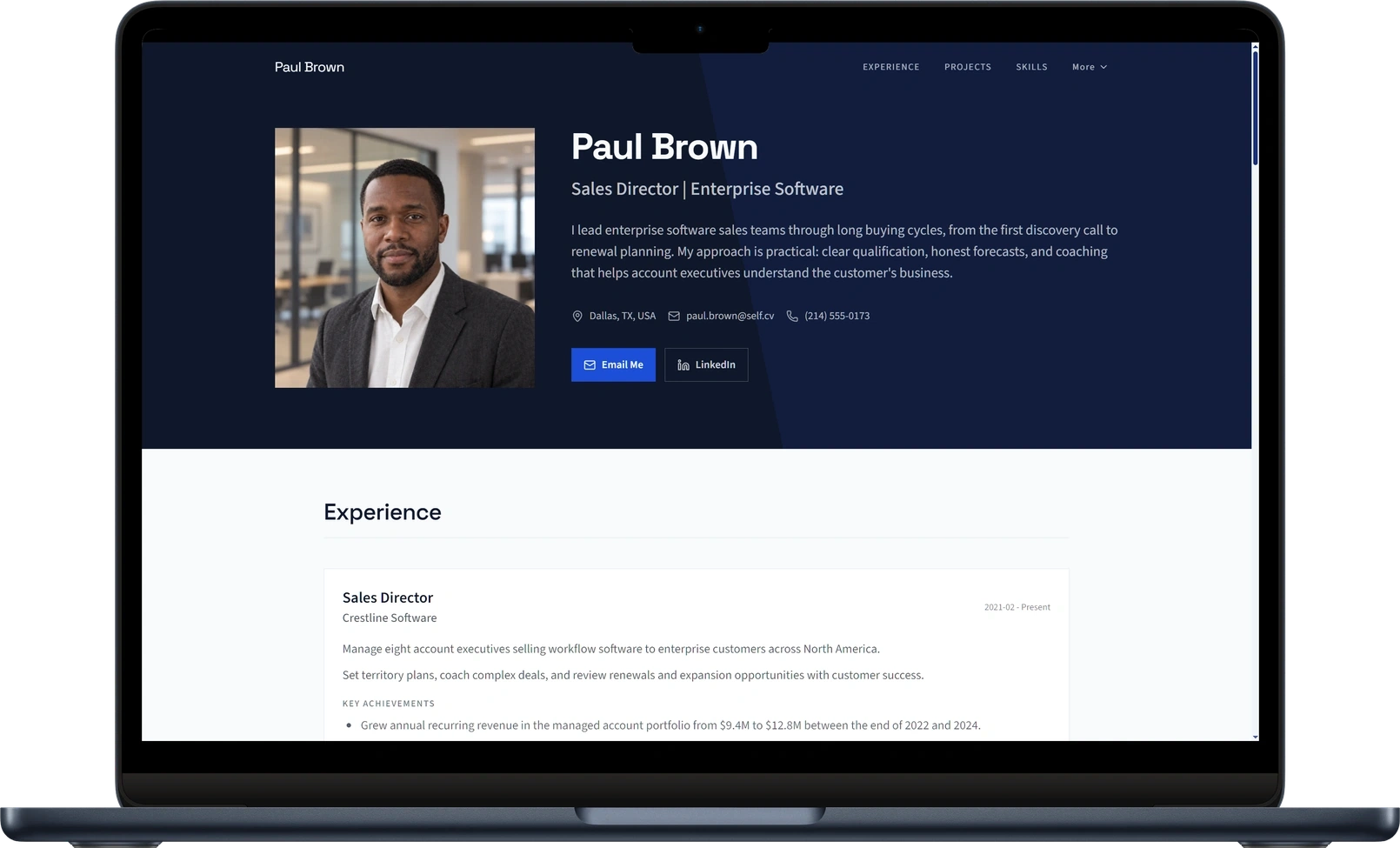
Start your professional website with Corporate, try Charcoal, or compare the full template collection.
Create the page from your CV and professional notes
Upload your CV or a LinkedIn profile PDF, and add notes about your current focus or selected work. Self creates the professional page from that material. Refine the introduction, choose which roles deserve detail, and use project entries for cases that benefit from more context.
Your website can sit alongside LinkedIn and your application CV. Use the network profile for professional connections and the personal page as a focused destination for your story, selected work, and contact details. Existing articles, talks, or company pages can remain where they are; link to the material that supports your message.
You can preview Corporate and Charcoal before upgrading. Publishing either design requires Pro or Team; Free users can publish with a Free template. Paid plans also support connecting a domain you own. A custom address is an optional way to carry your professional identity across roles, while a Self subdomain also gives you a shareable public link.
A focused review before publishing
- Make your current role, availability, and intended audience easy to understand.
- Check responsibilities, dates, credentials, and any figures against the evidence you have.
- Publish only material you may share and obtain permission for any testimonial you include.
- Test the contact action, public work links, and mobile reading order.
Create your professional website, or explore how to connect a custom domain when you are ready to use your own address.
Questions about executive personal websites
It can give professional introductions, speaking contacts, and future opportunities a clear destination. Focus the page on the work you want to be known for and keep its purpose consistent with your current responsibilities.
A domain you own can provide a consistent professional address. You can also begin with a Self subdomain and decide on a custom address later.
Use the CV as source material, then choose the level of detail that helps your visitor. Lead with your present focus and strongest evidence, with the wider career history underneath.