

Marketing Portfolio Examples for Experienced Managers
Show the strategy behind your marketing work with three worked portfolio examples, a reusable case-study outline, and a clear website structure.

Javier Martínez Samblas
Founder of Self · AI-powered resume-to-website platform

Self turns your marketing CV and campaign notes into a professional website you can edit and publish. The useful starting point is the work behind the job titles: the audience you understood, the choices you made, and the evidence that helps someone assess your contribution.
For an experienced marketer, that evidence can be scattered across launches, content, internal communications, and several industries. A strong marketing portfolio gives the reader a clear route through it. The three fictional examples below give you a structure to adapt to your own experience.
What should a marketing portfolio show?
A marketing portfolio is a selected account of your work and judgment. A hiring manager needs to understand your responsibility, the commercial setting, and what your decisions changed. A campaign image or article link becomes much more useful when the explanation beside it answers those questions.
Content marketing
Useful evidence
An article, content plan, or sales resource
What the reader should understand
How audience research and editorial choices supported a business need
Product and go-to-market marketing
Useful evidence
Positioning, a launch page, or an enablement asset
What the reader should understand
How you chose an audience, shaped the message, and coordinated delivery
Corporate communications
Useful evidence
A communication plan, staff guide, or change narrative
What the reader should understand
How you made complex information understandable and actionable
| Your focus | Useful evidence | What the reader should understand |
|---|---|---|
| Content marketing | An article, content plan, or sales resource | How audience research and editorial choices supported a business need |
| Product and go-to-market marketing | Positioning, a launch page, or an enablement asset | How you chose an audience, shaped the message, and coordinated delivery |
| Corporate communications | A communication plan, staff guide, or change narrative | How you made complex information understandable and actionable |
Example 1: a content marketing portfolio
Imagine a content manager at a software business whose sales team repeatedly answers the same questions about implementation. The useful portfolio story is how the manager identified the gap and built a resource around it. A folder of published articles would leave that reasoning invisible.
- Context: prospects needed a clearer explanation of the work involved in adopting the product.
- Ownership: the marketer reviewed sales questions, interviewed a product specialist, and planned the resource.
- Decision: organize the guide around implementation stages rather than product features.
- Evidence: an annotated contents page, a published excerpt, and feedback showing how sales used the guide.
Example portfolio copy: Developed an implementation guide for prospects evaluating the platform. Turned recurring sales questions into a staged editorial plan, coordinated technical review, and produced a resource the sales team could use in follow-up conversations.
If you measured engagement or commercial influence, explain the period and how the metric was defined. If the resource was launched recently, show its purpose, quality, and use so far.
Example 2: a product marketing portfolio
For a product launch, distinguish the product outcome from the marketing work you owned. The engineering team may have delivered the feature; your contribution may have been discovering which customer problem to lead with and making the release understandable to buyers.
- Context: a new reporting feature needed a clear place in the existing product story.
- Ownership: the marketer synthesized customer interviews and coordinated positioning with sales and product.
- Decision: lead with faster operational review rather than a longer list of dashboard features.
- Evidence: a before-and-after message, a launch-page excerpt, and the sales briefing created for the release.
Example portfolio copy: Shaped the launch narrative for a reporting release. Combined customer interviews with sales feedback to define the main use case, then aligned the launch page, customer email, and sales briefing around that message.
A marketing manager can add the operating context: who contributed, which deadline mattered, and how the work was prioritized. That shows the management behind delivery.
Example 3: a communications portfolio
Communications work often has fewer public artifacts. A change in process, a distributed workforce, or an internal service launch can still make a strong case when you explain the audience and the action the communication needed to support.
- Context: employees across several locations needed consistent instructions for a new internal service.
- Ownership: the communicator gathered questions, agreed the message with service owners, and planned delivery.
- Decision: replace a long announcement with a short manager briefing and a task-based staff guide.
- Evidence: a recreated guide structure, the communication sequence, and the questions used to improve the material.
Example portfolio copy: Planned communications for an internal service rollout across multiple locations. Built a manager briefing and staff guide around common tasks, coordinated sign-off with service owners, and used employee questions to refine the launch material.
A marketing case-study template you can reuse
Situation
Question to answer
Who was the audience, and what did the business need?
Your responsibility
Question to answer
What did you personally own, and who else contributed?
Decision
Question to answer
Which choice mattered, and why did you make it?
Work produced
Question to answer
What can the reader inspect or understand concretely?
Evidence
Question to answer
What happened, over which period, and how was it measured?
Learning
Question to answer
What would you repeat or change in the next campaign?
| Part | Question to answer |
|---|---|
| Situation | Who was the audience, and what did the business need? |
| Your responsibility | What did you personally own, and who else contributed? |
| Decision | Which choice mattered, and why did you make it? |
| Work produced | What can the reader inspect or understand concretely? |
| Evidence | What happened, over which period, and how was it measured? |
| Learning | What would you repeat or change in the next campaign? |
Choose the measure that matches the objective. Qualified inquiries, useful sales conversations, resource adoption, or fewer repeated staff questions can each be relevant in a different case. Keep outputs, observed outcomes, and attributed commercial results distinct. Google Analytics also documents how different attribution models allocate conversion credit; a portfolio should make its own measurement basis clear.
For measurement terminology, see Google Analytics' conversion attribution guidance.
Give your marketing website a clear reading order
Start with a headline that connects your specialty to a recognizable setting. Instead of just Marketing Manager, try Content marketing manager helping commercial property teams understand complex software. Then use the page to substantiate that focus.
- Introduction: your specialty, audience, and the kind of work you want next.
- Selected cases: two or three examples with different decisions and evidence.
- Career history: enough chronology to understand your progression and responsibilities.
- Skills and credentials: methods and tools connected to the work above.
- Contact: one clear way to reach you, alongside relevant professional links.
A simple professional design gives the case studies and career history room to work together. Corporate suits experienced marketers who want a clear career overview. Editorial offers another direction when writing and selected publications deserve particular attention.
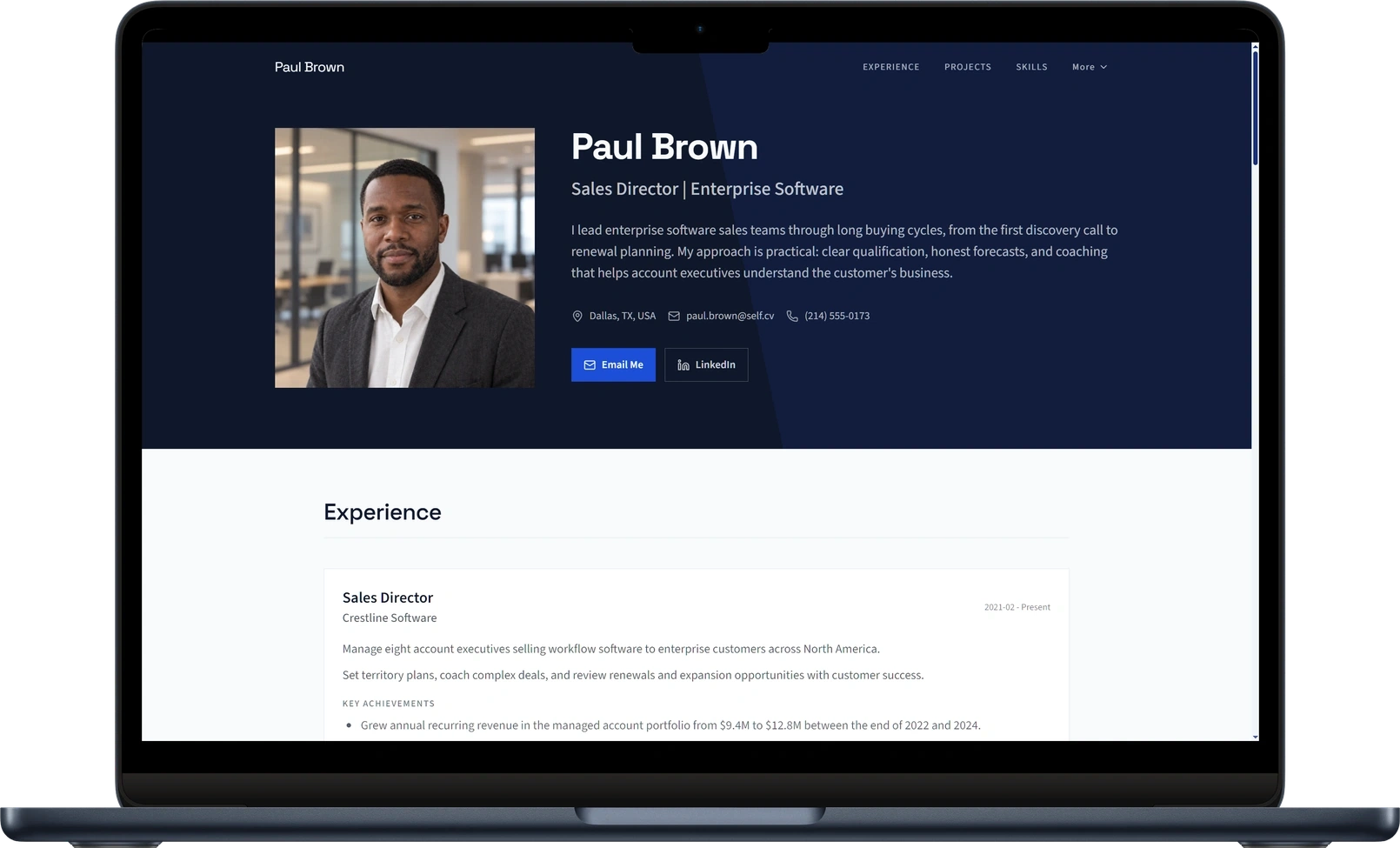
You can start your marketing website with Corporate or compare the portfolio templates.
Build your marketing portfolio from the material you have
Gather your CV, a few project notes, and the public links you want to feature. Self drafts the professional page from that material, so you can spend your editing time choosing the strongest cases and refining the message. Studio keeps the wording and emphasis under your control.
Add each selected case to Projects, use Work Experience for the career context, and attach useful images or links where they explain the work. Corporate and Editorial can be previewed before upgrading; publishing those designs requires Pro or Team. Free publishing is available with a Free template.
Before you share the page
- Check that each case distinguishes your contribution from the team effort.
- Give any result its relevant timeframe and measurement context.
- Use material you may publish; replace internal screenshots with clearly labeled reconstructions when needed.
- Open your work samples and contact links from a phone.
Create your marketing portfolio with Corporate, or read more about professional websites for marketers.
Questions about marketing portfolios
Yes. Show the problem, the decision, your contribution, and an appropriate artifact. A well-explained editorial plan or communication structure can demonstrate useful judgment even when commercial figures are unavailable.
You can start with a strong professional profile and selected examples inside your experience. Add project entries when a case needs more room, supporting media, or a direct link.
Select work that supports your next role or engagement. Keep the broader chronology in your career history and give detailed space to the cases that add something different.